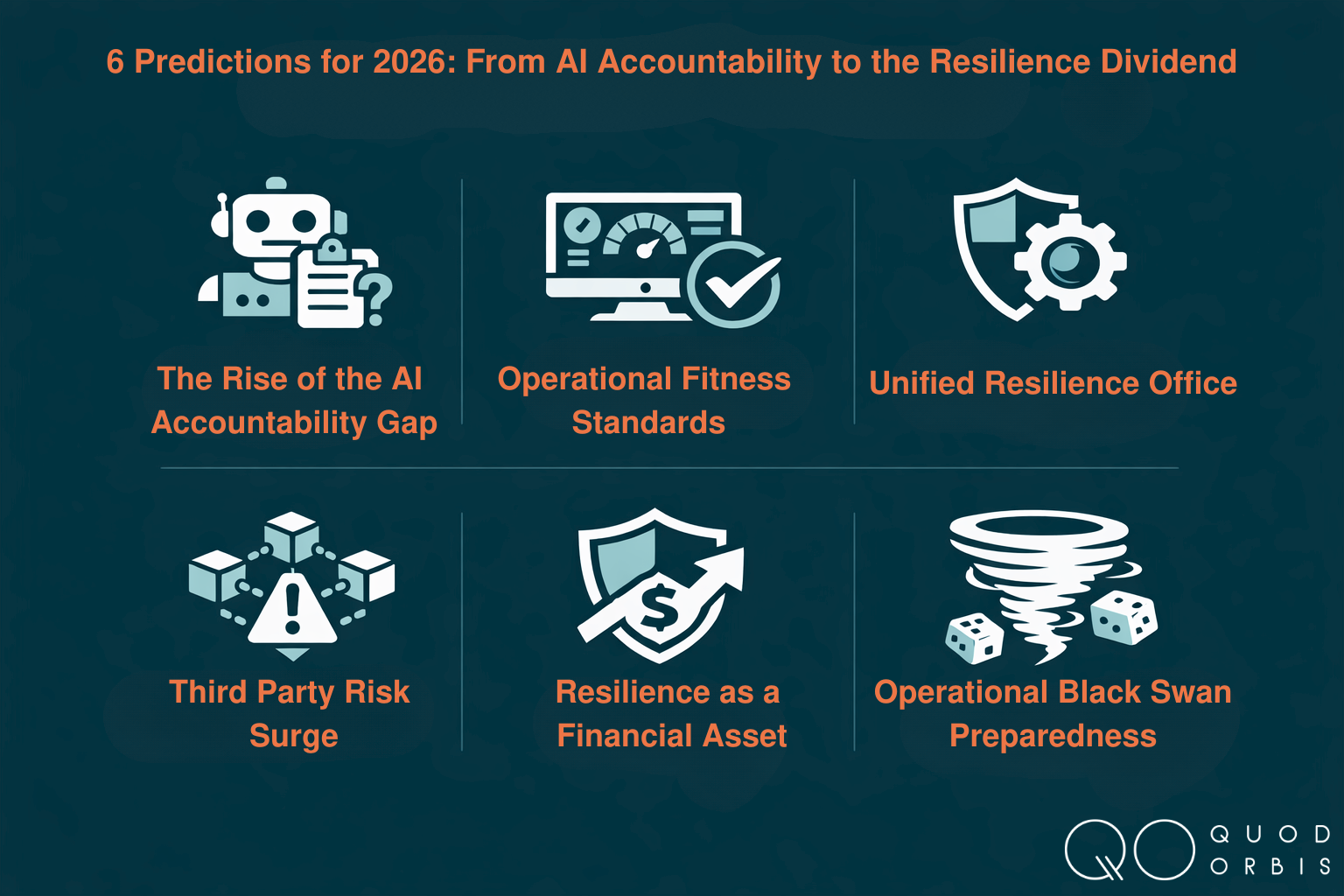
Every year, tech pundits release a flood of predictions more recently about AI, but always about cyber, and digital transformation. But most focus on adoption and hype, rarely anticipating the real-world fallout for boards, executives, and risk teams. As we step into 2026, the landscape is shifting faster than ever and only organisations that anticipate change will thrive. Here are six predictions shaping the year ahead.
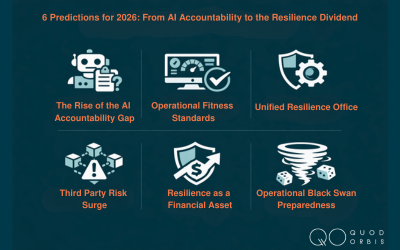
- The Decline of AI Hype and the Rise of the AI Accountability Gap
Everyone’s talking about more AI adoption, but few are asking the critical questions: Who is accountable when AI fails? How are decisions made, monitored, and controlled? In 2026, organisations will be forced to explain the provenance and integrity of every AI decision. Regulators won’t accept “the model did it” as an excuse.
Prediction: AI will become the #1 driver of controls monitoring, audit demand, and supply-chain transparency. Organisations will need robust frameworks to track AI decision-making, monitor model drift, and maintain continuous oversight — turning accountability from a technical detail into a board-level priority. Now this may take a time to come to fruition and it may even take for a high profile attack for this to happen (wrong way round of course) but it will become more pressing as 2026 moves on.
- Boards Will Demand Proof of Operational Fitness, Not Just Cyber Maturity
Cyber maturity scores are no longer enough. Boards will require assurance that organisations are operationally resilient, able to withstand AI failures, third-party outages, and rapid regulatory changes. Real-time, dynamic dashboards will replace static maturity scores, providing a continuous view of readiness across all critical business functions.
Prediction: Operational Fitness becomes a key board-level metric. Companies will be evaluated not just on their cyber posture, but on their ability to respond, recover, and adapt under pressure. Those without actionable, demonstrable operational fitness will struggle to attract investment and maintain stakeholder confidence.
- Controls, Security, and Resilience Converge into One Function
Today, governance, risk, compliance (GRC), cyber security, and IT operations operate in silos. By 2026, these boundaries will blur. Organisations will integrate these domains under a single executive office – a Digital Resilience Office – providing a unified view of risk, control, and operational health.
Prediction: The Digital Resilience Office becomes standard. By combining cyber security, compliance, and resilience, companies can streamline decision-making, reduce duplication, and ensure that risk oversight is both comprehensive and actionable.
- Third-Party Risk Becomes the Biggest Cyber Issue of the Decade
AI, SaaS, and API-driven ecosystems have created unprecedented interdependencies. One vendor outage or security breach can cascade across multiple industries. By 2026, third-party risk will eclipse ransomware and internal cyber threats as the primary source of operational disruption.
Prediction: Regulators will mandate real-time reporting of supplier risks. Organisations will need automated monitoring of vendor ecosystems, turning supplier risk management from a periodic checklist into a continuous strategic function.
- The Rise of the “Resilience Dividend” – Investors Value Resilience as a Financial Asset
Markets are beginning to price resilience. Companies with transparent operational practices, minimal supplier exposure, and proven recovery capabilities outperform peers in volatility-prone sectors. By 2026, resilience won’t be a qualitative assessment – it will be a measurable financial asset, influencing valuation and investment decisions.
Prediction: “Resilience Alpha” becomes a boardroom buzzword. Organisations demonstrating high resilience maturity will attract investors and strategic partners, while those lacking adaptive capability will see shareholder confidence erode.
- Operational Black Swan Preparedness Becomes a Competitive Differentiator
After years of reacting to cyber crises and supply chain failures, organisations will no longer be judged on past performance alone. In 2026, survival capability under extreme, unpredictable events – what we call “Operational Black Swan” preparedness – will be the ultimate differentiator.
Prediction: Companies will invest in stress-testing, chaos engineering, and scenario planning for everything from AI misfires to vendor collapses. Boards and executives will demand clear, tested plans for rare but high-impact events. Organisations that anticipate the unpredictable will not only survive, but they will also gain a resilience premium in the eyes of investors, customers, and partners.
Looking Ahead
2026 isn’t just about new technology adoption it’s about accountability, adaptability, and operational foresight. AI, cyber, resilience, and supply chain interdependencies will redefine how boards, investors, and regulators evaluate organisations. Companies that embrace these six predictions – and prepare for the unpredictable – will not only protect themselves from risk but turn resilience into a strategic advantage. 2026 is the year to turn cyber security risk, operational resilience into a proactive engine rather than reactive to prepare for the ever evolving landscape.
For more information on continuously monitoring your environment visit our ccm page here.