
Book a Demo
Skip to content
Australia mooted recently at the start of 2023 that, following an attack on Medibank Private Ltd, preceded by a considerable rise in ransomware attacks on some high-profile companies affecting millions of Australians, they would consider the move to pass law that meant paying ransomware would become illegal.
The question is, would such a move place pressure on other countries to follow as, ultimately, should such a law be passed in Australia, then the severity of attacks would only further increase in other countries. Also, surely taking a step such as this should be a global consideration to really combat these ransomware criminals?
So whether the UK should take the leap to make ransomware illegal is one fraught with many considerations and there is no simple answer.
Without doubt, ransomware attacks are becoming more and more prevalent in business life. It’s surging at such a pace that it is predicted to total a cost of $42 billion by 2024. The UK Government has even made ransomware attacks a Tier 1 national security threat. So the threat is ever present – ever evolving.
Our CTO, Gary Penolver recently wrote an article in Enterprise Times exploring the increasing severity of ransomware attacks; multiple extortion tactics, RaaS and supply chain attacks being the key drivers, and how fundamentally there are 5 key controls that each business should implement to decrease the risk of an attack.
However, the terrifying reality is that often these key controls have not been implemented to protect business assets and ultimately, as we have seen with some recent high profile UK cases, this has devastating and long-term effects on operations. This accentuates the harsh reality, that enterprise businesses still have not engaged proactively in protecting from such an attack.
So, once a Ransomware attack has occurred, should paying be an option?
Many businesses will potentially consider this move because they have not fundamentally protected their assets, nor have a plan to roll back their systems to provide access to their staff and clean hardware to minimise the impact of an attack. But really if this has happened it has gone too far.
Not only will the criminals have shut your operations down but, more importantly, they have your data. And payment has happened because of the devastating effect the ransomware attack has had on some major enterprises.
Unconfirmed reports indicated that CNA Financial paid a whopping $40 million, whilst closer to home Travelex paid $2.3 million to obtain access once again to their data. No one knows whether they actually did or not. More recently, the Royal Mail’s attackers still have an ongoing issue with their attackers – LockBit escalating their threats that the ransomware gang will publish the data it holds – so will they pay?
You can understand with such valuable high stakes that a company might pay out. The ransomware gangs have your data, they are holding your entire organisation to ransom!
Let’s be honest, how can you trust gangs that are holding your company data to ransom to release that data back to you when you pay?
This is a dangerous game to play.
Last week the UK Government announced that they had sanctioned 7 known individuals that they believe are committing some of these attacks, freezing assets in a coordinated attempt with the UK. Foreign Secretary James Cleverly commenting:
“By sanctioning these cyber criminals, we are sending a clear signal to them and others involved in ransomware that they will be held to account.”
This is a move that signifies the seriousness with which the UK Government are now treating these situations and should be a clear warning sign to any business that has not significantly improved their security and tightened their controls, that paying is not the answer.
Regardless of recent developments, paying the ransomware gangs not only encourages them to do the same to other businesses – opens you up for other ransomware gangs to target you and you can’t even be sure if they provide the decryption key whether your data is not already corrupted!
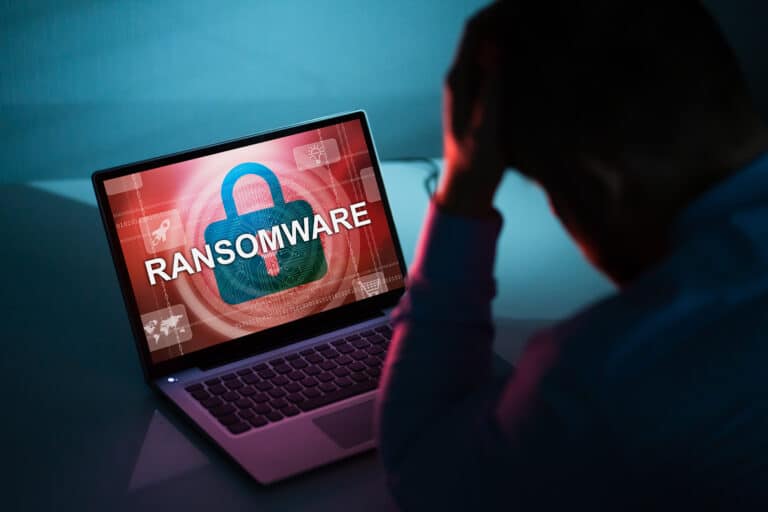
The UK Government announcement last week is a very good indicator that there are moves to tighten laws. The sanctions alone mean that if you are attacked by one of the 7 sanctioned criminals your business could be liable to legal action.
“It is an offence under sanctions law to make funds available directly or indirectly to a “designated” individual or entity. Those designated individuals appear on lists published by OFSI (the Office of Financial Sanctions Implementation) in the UK.” [1]
NCSC founder Ciaran Martin recently commented in an interview with SC Magazine that “In principle, it should be made illegal to pay ransoms, but there are many people whom I respect who disagree. In most walks of life it is normally illegal to give money to criminals, even if you’re in a desperate situation. I would start a policy review on the presumption that burden-of-proof would be on those who think they should not be illegal to prove their case.”
So it is evident that not only are the UK and US Governments treating this as a terrorist act, but that there are moves to tighten laws, if not make it totally illegal to pay.
Ultimately, in hypothesis, it’s easy to say that you won’t pay, but when the situation arises, which is becoming more and more likely if you’re ransomware controls and security are not tightly in place, then you really cannot guess how you as a business will react. Making it illegal in essence will sharpen businesses minds to become more robust in their security and their controls – at least there will be clear guidance as to what the perimeters are in the face of attack.
However, right now, if you are held to ransom, you should take account of not only legal implications, but commercial and reputational issues. But the right path will always vary depending on your business industry and size; but the consequences of paying or not paying should be at the forefront of your mind.
Build a cyber resilience strategy that’s robust
Essentially to avoid all of this, and in view of the recent sanctions, the right answer must surely be to implement a cyber resilience strategy that enables your business to be confident in its approach and protect it’s reputation, covering off the key areas of:
Then test, test test.
Essentially the answer is to be prepared so that regardless of whether it paying ransomware becomes illegal or not, the threat to your business as a result of attack is significantly reduced. Don’t be a statistic.
[1] Ransomware: to pay or not to pay? – Osborne Clarke | Osborne Clarke
To find out more about how we can support you with cyber resilience and visibility of your security, risk and compliance posture, then do reach out.
To find out more about cyber security and Continuous Controls Monitoring, please complete the form below with a short message and we’ll get right back to you. Alternatively, you can book a meeting directly.
Address:
5th Floor,
72 King William Street,
London,
EC4N 7HR
Email:
[email protected]
Please register your contact details with us to receive links to insightful blog articles as soon as they are published.
Address:
2nd & 3rd Floor,
2 Burgon Street,
City Of London,
London,
EC4V 5DR
Email:
[email protected]
Please register your contact details with us to receive links to insightful blog articles as soon as they are published.