Book a Demo
Skip to contentWeighing Quod Orbis against Panaseer? Here's how each platform performs across the criteria that matter most.

If you're evaluating continuous controls monitoring platforms, you'll likely come across both. They're not the same thing — and understanding the difference matters before you commit. This page sets out an honest comparison. Where Panaseer is strong, we'll say so. Where the use cases diverge, we'll be direct about that too.
Any control, any system, any environment
Cyber security tooling only
Connector-agnostic — no predefined list
100+ named tool connectors
Predictive scoring, prioritisation & remediation guidance
Explains why risk has changed (diagnostic)
Fully integrated
Not included
Pre-mapped, continuously maintained
Partial and evolving
Calibrated for every level of the organisation
CISO-level metrics; requires translation
Any data source, without rip-and-replace
Security tooling focused
Mid-market and enterprise
Enterprise only
Modular tiers, published
Custom quote only
Included as standard
Available
At a glance
Any control, any system, any environment
Cyber security tooling only
Connector-agnostic — no predefined list
100+ named tool connectors
Predictive scoring, prioritisation & remediation guidance
Explains why risk has changed (diagnostic)
Fully integrated
Not included
Pre-mapped, continuously maintained
Partial and evolving
Calibrated for every level of the organisation
CISO-level metrics; requires translation
Any data source, without rip-and-replace
Security tooling focused
Mid-market and enterprise
Enterprise only
Modular tiers, published
Custom quote only
Included as standard
Available

Quod Orbis is a continuous controls monitoring platform built on a different premise: that most organisations do not have a security problem and a compliance problem and an audit problem — they have one problem, fragmented across too many tools.
The platform runs 24/7, detecting control drift the moment it happens. It connects to any data source — cloud, on-premises, legacy systems, IoT — without requiring you to change your existing architecture. And it monitors any control: bespoke, niche, or industry-standard.
“As the business has seen the power of Continuous Controls Monitoring, and seen how Quod Orbis literally can connect to almost any control, we’ve implemented CCM in areas that weren’t originally envisaged.” — Head of Cyber Oversight, Direct Line |
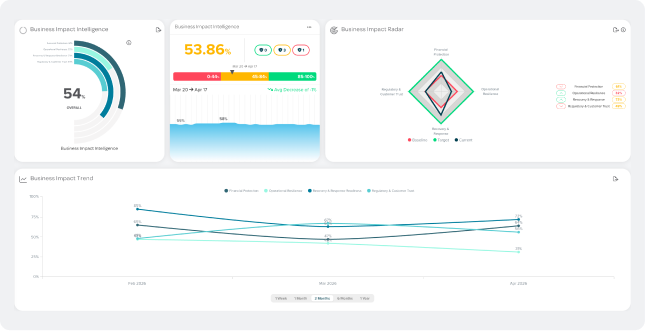
Where Panaseer gives your CISO a view of security control health, Quod Orbis gives your CISO, your risk director, your compliance team, your board, and your regulator a view of control health — calibrated for each audience, from the same live data.

Panaseer is one of the earlier vendors to operationalise continuous controls monitoring at scale. It was built specifically for large enterprises — financial services, critical infrastructure, global businesses with mature security stacks — and it does that job well.
Its 100+ connectors pull data from your security tooling: endpoint platforms, vulnerability scanners, identity systems, cloud controls. It normalises that data, maps it to defined control objectives, and produces the scorecards and KPI dashboards that CISOs use to understand where their security programme has gaps.
The constraint is scope. Panaseer monitors your security controls. It does not monitor your broader control estate — operational controls, compliance obligations, IT governance, third-party risk. And its outputs, while excellent for security leadership, require considerable translation before they are useful for boards, audit committees, or regulators.

Quod Orbis is a continuous controls monitoring platform built on a different premise: that most organisations do not have a security problem and a compliance problem and an audit problem — they have one problem, fragmented across too many tools.
The platform runs 24/7, detecting control drift the moment it happens. It connects to any data source — cloud, on-premises, legacy systems, IoT — without requiring you to change your existing architecture. And it monitors any control: bespoke, niche, or industry-standard.
“As the business has seen the power of Continuous Controls Monitoring, and seen how Quod Orbis literally can connect to almost any control, we’ve implemented CCM in areas that weren’t originally envisaged.” — Head of Cyber Oversight, Direct Line |
Where Panaseer gives your CISO a view of security control health, Quod Orbis gives your CISO, your risk director, your compliance team, your board, and your regulator a view of control health — calibrated for each audience, from the same live data.
Panaseer is one of the earlier vendors to operationalise continuous controls monitoring at scale. It was built specifically for large enterprises — financial services, critical infrastructure, global businesses with mature security stacks — and it does that job well.
Its 100+ connectors pull data from your security tooling: endpoint platforms, vulnerability scanners, identity systems, cloud controls. It normalises that data, maps it to defined control objectives, and produces the scorecards and KPI dashboards that CISOs use to understand where their security programme has gaps.
The constraint is scope. Panaseer monitors your security controls. It does not monitor your broader control estate — operational controls, compliance obligations, IT governance, third-party risk. And its outputs, while excellent for security leadership, require considerable translation before they are useful for boards, audit committees, or regulators.

Panaseer monitors your cyber security controls. Endpoint coverage, patch compliance, identity hygiene, vulnerability exposure, cloud configuration — the domain of the security team. It is deep and credible in this space.
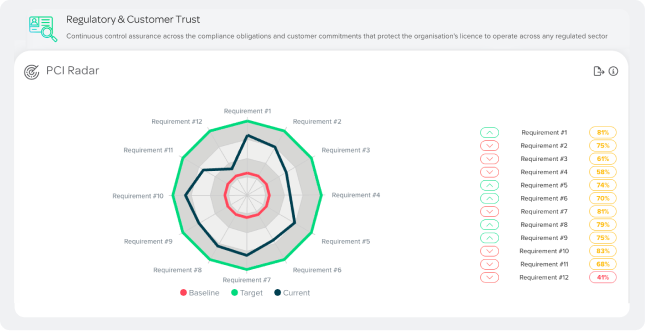
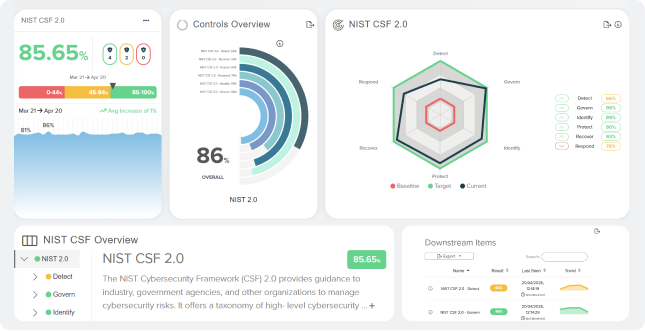
Quod Orbis monitors your entire control estate. Cyber security controls, yes. But also IT governance controls, operational resilience controls, compliance framework obligations, third-party risk controls, and regulatory requirements. The same platform, the same live data, mapped to whatever matters to your organisation.
Organisations using Quod Orbis typically see a 75% reduction in audit preparation time — because the evidence is continuously collected, always current, and the AI has already flagged what needs attention before the auditor arrives.

Panaseer’s AI analyses control data to explain why risk has changed — useful context for security teams trying to understand the story behind a metric. That is useful. It reduces manual effort and speeds up work that was already in the process.
Quod Orbis uses AI differently. The platform applies predictive risk scoring to your live control data — identifying which controls are most likely to fail, which risks are compounding, and what needs to be addressed first. Prioritisation is not manual. Remediation guidance is not generic. The AI works from your actual control environment, continuously updated, to surface what matters most before it becomes a problem.
The distinction matters: Panaseer’s AI looks backward and explains. Quod Orbis’s AI looks forward and acts — telling you which controls are most likely to fail, which risks to address first, and what remediation to prioritise. For teams under pressure to do more with less, that difference is the difference between information and direction.
Panaseer’s integration model is built around a catalogue of named security tools. 100+ connectors is a substantial list. But a catalogue has edges. If your tooling sits outside it — legacy systems, operational technology, bespoke applications — integration requires additional effort.
Quod Orbis does not have a connector catalogue. It connects to any data source, full stop. Cloud, on-premises, legacy, IoT, OT, custom applications. The architecture was designed this way deliberately, because the organisations that need continuous controls monitoring most are rarely the ones with clean, modern, uniform technology stacks.
“We’ve had some light bulb moments in the platform where particularly around vulnerabilities, the CCM platform has highlighted things we simply didn’t know.” — Chris Taylor, Cyber Security Lead, Martin Baker |

Panaseer monitors your cyber security controls. Endpoint coverage, patch compliance, identity hygiene, vulnerability exposure, cloud configuration — the domain of the security team. It is deep and credible in this space.
Quod Orbis monitors your entire control estate. Cyber security controls, yes. But also IT governance controls, operational resilience controls, compliance framework obligations, third-party risk controls, and regulatory requirements. The same platform, the same live data, mapped to whatever matters to your organisation.
Organisations using Quod Orbis typically see a 75% reduction in audit preparation time — because the evidence is continuously collected, always current, and the AI has already flagged what needs attention before the auditor arrives.
Panaseer’s AI analyses control data to explain why risk has changed — useful context for security teams trying to understand the story behind a metric. That is useful. It reduces manual effort and speeds up work that was already in the process.
Quod Orbis uses AI differently. The platform applies predictive risk scoring to your live control data — identifying which controls are most likely to fail, which risks are compounding, and what needs to be addressed first. Prioritisation is not manual. Remediation guidance is not generic. The AI works from your actual control environment, continuously updated, to surface what matters most before it becomes a problem.
The distinction matters: Panaseer’s AI looks backward and explains. Quod Orbis’s AI looks forward and acts — telling you which controls are most likely to fail, which risks to address first, and what remediation to prioritise. For teams under pressure to do more with less, that difference is the difference between information and direction.
Panaseer’s integration model is built around a catalogue of named security tools. 100+ connectors is a substantial list. But a catalogue has edges. If your tooling sits outside it — legacy systems, operational technology, bespoke applications — integration requires additional effort.
Quod Orbis does not have a connector catalogue. It connects to any data source, full stop. Cloud, on-premises, legacy, IoT, OT, custom applications. The architecture was designed this way deliberately, because the organisations that need continuous controls monitoring most are rarely the ones with clean, modern, uniform technology stacks.
“We’ve had some light bulb moments in the platform where particularly around vulnerabilities, the CCM platform has highlighted things we simply didn’t know.” — Chris Taylor, Cyber Security Lead, Martin Baker |

Which one is right for you?
Quod Orbis tends to be the right fit when…
Drata tends to be the right fit when…
Connect to your existing tools
The solution integrates with any data source, whether cloud, on premises or legacy, without requiring rip-and-replace.
Monitor controls continuously
The solution runs 24/7, detecting control drift the moment it happens and alerting your teams before it becomes a business risk or compliance failure.
Translate signals into impact
The solution correlates and contextualises data, delivering KRI and KPI dashboards calibrated for every level of your organisation.
Drata is an excellent product for organisations whose primary need is compliance automation in SaaS-heavy environments. It does that job well and at scale. Quod Orbis is for organisations where compliance is one part of a broader assurance requirement — where AI-driven risk prioritisation, security control effectiveness, board reporting, and continuous monitoring all need to work together. If audit readiness is the goal, Drata gets you there. If continuous assurance is the goal, Quod Orbis goes further.
To find out more about cyber security and Continuous Controls Monitoring, please complete the form below with a short message and we’ll get right back to you. Alternatively, you can book a meeting directly.
Address:
5th Floor,
72 King William Street,
London,
EC4N 7HR
Email:
[email protected]
Please register your contact details with us to receive links to insightful blog articles as soon as they are published.
Address:
2nd & 3rd Floor,
2 Burgon Street,
City Of London,
London,
EC4V 5DR
Email:
[email protected]
Please register your contact details with us to receive links to insightful blog articles as soon as they are published.