Book a Demo
Skip to contentSee how Quod Orbis and UpGuard stack up side by side.
Explore feature-by-feature differences to find the right fit for your team.

If you're evaluating compliance and CCM platforms, Drata will almost certainly come up. It should. It's a well-funded, well-built product that has grown fast for good reason. But it was built to solve a specific problem — and understanding that problem, and whether it's yours, is what this page is about.
At a glance
Fully integrated
Core strength
Any control, any system, any environment
Compliance state tracking
Connector-agnostic — no predefined list
Named SaaS integrations
Predictive scoring, prioritisation & remediation guidance
Automates evidence collection and form-filling
True control effectiveness and threat context
Compliance state only
Fully integrated
Partial and evolving
Pre-mapped, continuously maintained
Partial
Calibrated for every level of the organisation
Compliance team dashboards
Any data source, without rip-and-replace
Cloud and SaaS focused
Available
Demo required
Modular tiers, published
Available
Included as standard

Quod Orbis is a continuous controls monitoring platform built on a different premise. Most organisations do not have a compliance problem separate from their security problem separate from their audit problem. They have one problem: they cannot see their entire control environment clearly, and the tools they use give them fragments rather than a complete picture.
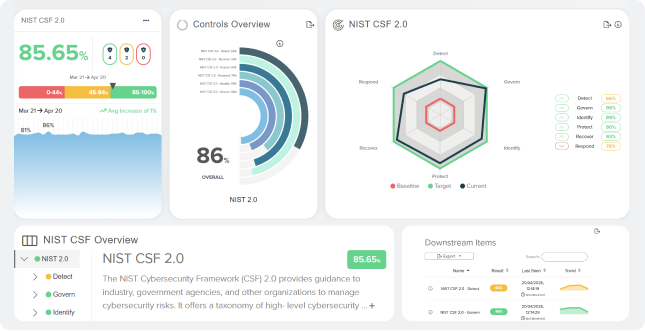
The platform runs 24/7, detecting control drift the moment it happens. It connects to any data source — cloud, on-premises, legacy systems, IoT — without requiring you to change your existing architecture. And it delivers reporting calibrated for every audience, from operational teams to boards to regulators.
“The real difference is in the quality of the security assurance and compliance information: we’re getting dramatically-better, higher-quality information — and we’re getting it continuously.” — David Wigley, CISO, Daiwa |
Where Drata tells you whether you are compliant, Quod Orbis tells you whether your controls are actually working — and what the business risk is if they are not.

Drata is a compliance automation platform. It crossed $100 million in annual recurring revenue in early 2025, which tells you something about how many organisations need what it does. Its core job is to automate evidence collection, monitor controls against compliance frameworks, and keep your organisation audit-ready without the manual grind.
It integrates with the tools most SaaS businesses already use — GitHub, AWS, Okta, Google Workspace — and continuously pulls evidence that maps to frameworks like SOC 2, ISO 27001, HIPAA, and GDPR. When an auditor comes knocking, your evidence is already there.
The constraint is what Drata was built to do. It tracks compliance state. It tells you whether a control is passing or failing against a framework requirement. What it does not tell you is whether that control is actually working — whether the underlying security posture is sound, or whether a gap in one area creates risk somewhere else entirely.

Quod Orbis is a continuous controls monitoring platform built on a different premise. Most organisations do not have a compliance problem separate from their security problem separate from their audit problem. They have one problem: they cannot see their entire control environment clearly, and the tools they use give them fragments rather than a complete picture.
The platform runs 24/7, detecting control drift the moment it happens. It connects to any data source — cloud, on-premises, legacy systems, IoT — without requiring you to change your existing architecture. And it delivers reporting calibrated for every audience, from operational teams to boards to regulators.
“The real difference is in the quality of the security assurance and compliance information: we’re getting dramatically-better, higher-quality information — and we’re getting it continuously.” — David Wigley, CISO, Daiwa |
Where Drata tells you whether you are compliant, Quod Orbis tells you whether your controls are actually working — and what the business risk is if they are not.
Drata is a compliance automation platform. It crossed $100 million in annual recurring revenue in early 2025, which tells you something about how many organisations need what it does. Its core job is to automate evidence collection, monitor controls against compliance frameworks, and keep your organisation audit-ready without the manual grind.
It integrates with the tools most SaaS businesses already use — GitHub, AWS, Okta, Google Workspace — and continuously pulls evidence that maps to frameworks like SOC 2, ISO 27001, HIPAA, and GDPR. When an auditor comes knocking, your evidence is already there.
The constraint is what Drata was built to do. It tracks compliance state. It tells you whether a control is passing or failing against a framework requirement. What it does not tell you is whether that control is actually working — whether the underlying security posture is sound, or whether a gap in one area creates risk somewhere else entirely.

Audit-ready and continuously-assured are not the same thing. Audit-ready means you can demonstrate compliance at a point in time. Continuously-assured means you know your controls are working right now — and you will know the moment they stop.
For organisations operating under DORA, NIS2, or FCA expectations, regulators are increasingly uninterested in point-in-time evidence. They want to see that you operate in a continuous state of control. That is a different standard — and it requires a different kind of platform.

Drata’s AI automates the collection and filing of compliance evidence — it fills in forms, links records to framework controls, and keeps audit preparation moving without manual intervention. That is useful. It reduces manual effort and speeds up work that was already in the process.
Quod Orbis uses AI differently. The platform applies predictive risk scoring to your live control data — identifying which controls are most likely to fail, which risks are compounding, and what needs to be addressed first. Prioritisation is not manual. Remediation guidance is not generic. The AI works from your actual control environment, continuously updated, to surface what matters most before it becomes a problem.
The difference is what the AI is working on. Drata’s AI processes compliance administration — important, but backward-looking. Quod Orbis’s AI works on your live risk data — predicting which controls are most likely to deteriorate, scoring risks by business impact, and telling your team what to fix first. One saves time on paperwork. The other changes what decisions you make.
Drata integrates with hundreds of named SaaS tools and cloud providers. For organisations that live predominantly in that world, the coverage is strong. The limitation appears at the edges — legacy systems, on-premises infrastructure, operational technology, bespoke applications — these sit outside Drata’s integration model.
Quod Orbis has no integration list. It connects to any data source, full stop. You cannot protect what you cannot see, and you cannot see what your tools cannot reach.

Audit-ready and continuously-assured are not the same thing. Audit-ready means you can demonstrate compliance at a point in time. Continuously-assured means you know your controls are working right now — and you will know the moment they stop.
For organisations operating under DORA, NIS2, or FCA expectations, regulators are increasingly uninterested in point-in-time evidence. They want to see that you operate in a continuous state of control. That is a different standard — and it requires a different kind of platform.
Drata’s AI automates the collection and filing of compliance evidence — it fills in forms, links records to framework controls, and keeps audit preparation moving without manual intervention. That is useful. It reduces manual effort and speeds up work that was already in the process.
Quod Orbis uses AI differently. The platform applies predictive risk scoring to your live control data — identifying which controls are most likely to fail, which risks are compounding, and what needs to be addressed first. Prioritisation is not manual. Remediation guidance is not generic. The AI works from your actual control environment, continuously updated, to surface what matters most before it becomes a problem.
The difference is what the AI is working on. Drata’s AI processes compliance administration — important, but backward-looking. Quod Orbis’s AI works on your live risk data — predicting which controls are most likely to deteriorate, scoring risks by business impact, and telling your team what to fix first. One saves time on paperwork. The other changes what decisions you make.
Drata integrates with hundreds of named SaaS tools and cloud providers. For organisations that live predominantly in that world, the coverage is strong. The limitation appears at the edges — legacy systems, on-premises infrastructure, operational technology, bespoke applications — these sit outside Drata’s integration model.
Quod Orbis has no integration list. It connects to any data source, full stop. You cannot protect what you cannot see, and you cannot see what your tools cannot reach.

Which one is right for you?
Quod Orbis tends to be the right fit when…
Drata tends to be the right fit when…
Connect to your existing tools
The solution integrates with any data source, whether cloud, on premises or legacy, without requiring rip-and-replace.
Monitor controls continuously
The solution runs 24/7, detecting control drift the moment it happens and alerting your teams before it becomes a business risk or compliance failure.
Translate signals into impact
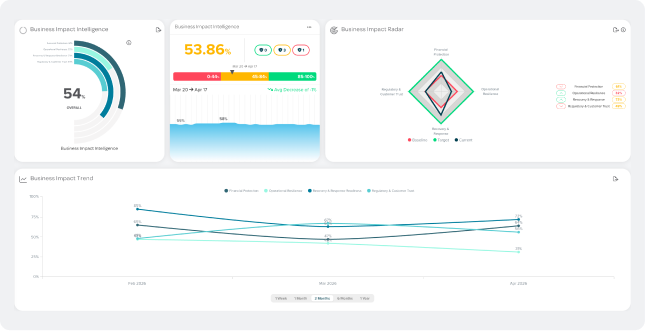
The solution correlates and contextualises data, delivering KRI and KPI dashboards calibrated for every level of your organisation.
Drata is an excellent product for organisations whose primary need is compliance automation in SaaS-heavy environments. It does that job well and at scale. Quod Orbis is for organisations where compliance is one part of a broader assurance requirement — where AI-driven risk prioritisation, security control effectiveness, board reporting, and continuous monitoring all need to work together. If audit readiness is the goal, Drata gets you there. If continuous assurance is the goal, Quod Orbis goes further.
To find out more about cyber security and Continuous Controls Monitoring, please complete the form below with a short message and we’ll get right back to you. Alternatively, you can book a meeting directly.
Address:
5th Floor,
72 King William Street,
London,
EC4N 7HR
Email:
[email protected]
Please register your contact details with us to receive links to insightful blog articles as soon as they are published.
Address:
2nd & 3rd Floor,
2 Burgon Street,
City Of London,
London,
EC4V 5DR
Email:
[email protected]
Please register your contact details with us to receive links to insightful blog articles as soon as they are published.