Book a Demo
Skip to contentSee how Quod Orbis and UpGuard stack up side by side.
Explore feature-by-feature differences to find the right fit for your team.

UpGuard is trusted by 45,000 companies worldwide. That is not a small number. It reflects a platform that genuinely solves a real problem at scale. Understanding that problem, and whether it is the same problem you have, is what this comparison is about.
Core strength
Fully integrated
Core strength
Via continuous controls monitoring
Source-agnostic — any tool, custom system, OT or legacy
SaaS and cloud focus
Scores third-party risk from external data
Predictive scoring, prioritisation & remediation guidance
Any control, any system, any environment
Not covered
Fully integrated
Not covered
Connector-agnostic — no predefined list
Internet-facing assets and vendor posture
Any data source, without rip-and-replace
Cloud and SaaS focused
Calibrated for every level of the organisation
Vendor scorecards and posture dashboards
Modular tiers, published
Published tiers from $1,599/month
Included as standard
Available as a paid add-on
At a glance
Core strength
Fully integrated
Core strength
Via continuous controls monitoring
Source-agnostic — any tool, custom system, OT or legacy
SaaS and cloud focus
Scores third-party risk from external data
Predictive scoring, prioritisation & remediation guidance
Any control, any system, any environment
Not covered
Fully integrated |
Not covered
Connector-agnostic — no predefined list
Internet-facing assets and vendor posture
Any data source, without rip-and-replace
Cloud and SaaS focused
Calibrated for every level of the organisation
Vendor scorecards and posture dashboards
Modular tiers, published
Published tiers from $1,599/month
Included as standard
Available as a paid add-on

Quod Orbis is a continuous controls monitoring platform. Where UpGuard monitors what is happening outside your organisation, Quod Orbis monitors what is happening inside it — and connects that to the external picture in a single platform.
The platform runs 24/7, connecting to any data source without a predefined integration list. It monitors any control, maps to any framework, and delivers reporting calibrated for every audience from operational teams to boards to regulators. Third-party risk sits within the platform, connected to your internal control posture rather than sitting alongside it as a separate tool.
“The real difference is in the quality of the security assurance and compliance information: we’re getting dramatically-better, higher-quality information — and we’re getting it continuously.” — David Wigley, CISO, Daiwa |

UpGuard is an external risk platform. Its job is to look outward — at your vendors, your attack surface, and the security posture of the third parties your organisation depends on. It does this with AI-powered questionnaires, automated security ratings, continuous vendor monitoring, and attack surface scanning.
The boundary is consistent throughout. UpGuard looks outward. Internal governance, continuous control monitoring of your own systems, compliance framework mapping, audit evidence, GRC workflows — these sit outside what the platform does. That is a deliberate product decision that makes UpGuard excellent at its primary job. The question is whether that job is the complete picture of what you need.

Quod Orbis is a continuous controls monitoring platform. Where UpGuard monitors what is happening outside your organisation, Quod Orbis monitors what is happening inside it — and connects that to the external picture in a single platform.
The platform runs 24/7, connecting to any data source without a predefined integration list. It monitors any control, maps to any framework, and delivers reporting calibrated for every audience from operational teams to boards to regulators. Third-party risk sits within the platform, connected to your internal control posture rather than sitting alongside it as a separate tool.
“The real difference is in the quality of the security assurance and compliance information: we’re getting dramatically-better, higher-quality information — and we’re getting it continuously.” — David Wigley, CISO, Daiwa |
UpGuard is an external risk platform. Its job is to look outward — at your vendors, your attack surface, and the security posture of the third parties your organisation depends on. It does this with AI-powered questionnaires, automated security ratings, continuous vendor monitoring, and attack surface scanning.
The boundary is consistent throughout. UpGuard looks outward. Internal governance, continuous control monitoring of your own systems, compliance framework mapping, audit evidence, GRC workflows — these sit outside what the platform does. That is a deliberate product decision that makes UpGuard excellent at its primary job. The question is whether that job is the complete picture of what you need.

UpGuard uses AI to score third-party cyber risk from external data — scanning vendor posture, reviewing questionnaire evidence, and surfacing risk signals from internet-facing infrastructure. That is useful. It reduces manual effort and speeds up work that was already in the process. UpGuard's AI scores the risk presented by others. One looks outward and rates.
Quod Orbis uses AI differently. The platform applies predictive risk scoring to your live control data — identifying which controls are most likely to fail, which risks are compounding, and what needs to be addressed first. Prioritisation is not manual. Remediation guidance is not generic. The AI works from your actual control environment, continuously updated, to surface what matters most before it becomes a problem. Quod Orbis's AI scores the risk within your own control environment — predicting which of your controls are most likely to fail, ranking risks by business impact, and telling your team what to remediate first. The other looks inward and acts.
Most organisations eventually discover they need both perspectives. Two separate tools mean two data sources, two dashboards, and the manual work of connecting what each tells you. When a vendor's security posture degrades and that creates a compliance exposure in your own programme, knowing that requires someone to look at both tools and join the dots. Systems do not join dots — people do, and people miss things. Quod Orbis removes that gap. Internal and external risk in the same platform, connected to the same compliance evidence, surfaced in the same reporting. For regulated organisations where the relationship between vendor risk and internal compliance is structural — under DORA and NIS2, for example — that connection is not a convenience, it is a requirement.
Which one is right for you?
Quod Orbis tends to be the right fit when…
UpGuard tends to be the right fit when…
Connect to your existing tools
The solution integrates with any data source, whether cloud, on premises or legacy, without requiring rip-and-replace.
Monitor controls continuously
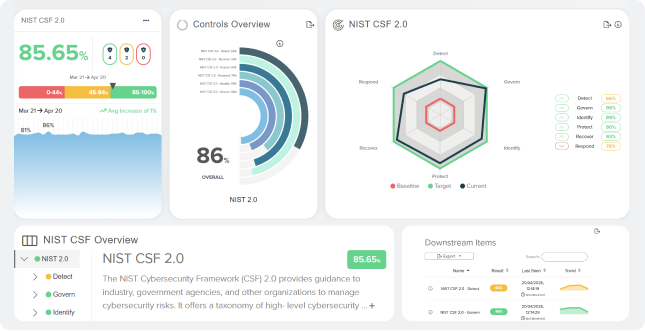
The solution runs 24/7, detecting control drift the moment it happens and alerting your teams before it becomes a business risk or compliance failure.
Translate signals into impact
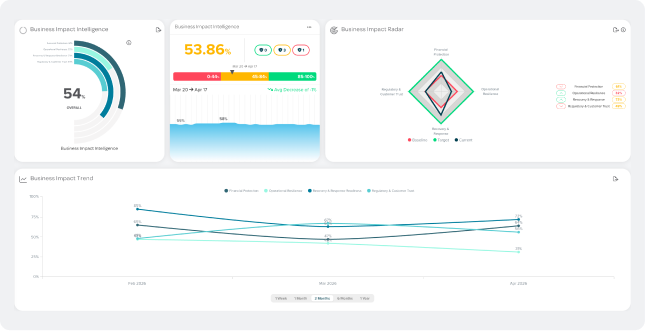
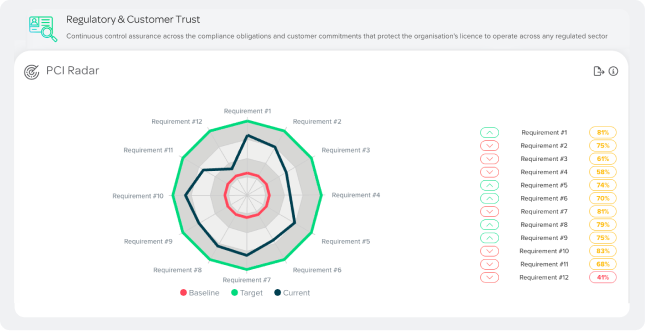
The solution correlates and contextualises data, delivering KRI and KPI dashboards calibrated for every level of your organisation.
UpGuard is a strong, accessible platform for organisations whose primary need is third-party vendor risk management and external attack surface monitoring. It is well-priced, well-built, and easy to get started with. Quod Orbis is for organisations that need external risk to connect to internal controls, AI-driven risk prioritisation, compliance, and regulatory assurance in a single platform. If UpGuard is already in your stack, Quod Orbis is not a replacement for its external scanning — it is a broader platform that makes that capability one part of a complete picture.
To find out more about cyber security and Continuous Controls Monitoring, please complete the form below with a short message and we’ll get right back to you. Alternatively, you can book a meeting directly.
Address:
5th Floor,
72 King William Street,
London,
EC4N 7HR
Email:
[email protected]
Please register your contact details with us to receive links to insightful blog articles as soon as they are published.
Address:
2nd & 3rd Floor,
2 Burgon Street,
City Of London,
London,
EC4V 5DR
Email:
[email protected]
Please register your contact details with us to receive links to insightful blog articles as soon as they are published.