
Book a Demo
Skip to contentQuod Orbis helps organisations design, implement and continuously prove their AI controls, from Shadow AI risk to regulatory compliance.
Quod Orbis is trusted by companies worldwide...




As cyber security threats grow more sophisticated and regulators tighten their grip, the gap between using AI and governing it safely becomes your biggest business risk. Quod Orbis delivers expert AI governance consulting to close that gap: pragmatically, permanently and with evidence to prove it.
Outside-in: attackers using AI against you
AI-enabled phishing and social engineering at scale. Multi-vector, simultaneous attacks. Deepfakes causing real financial losses. “Harvest now, decrypt later” nation-state threats.
Inside-out: your own AI without governance
Shadow AI: tools adopted faster than controls. Sensitive data exposed via prompts and outputs. AI agents acting without human checkpoints. Vibe coding: apps built without IT or InfoSec review.
Regulatory & compliance exposure
EU AI Act: fines up to €35m or 7% of global turnover. DORA: operational resilience mandates. NIS2: governance obligations. UK Cyber Security & Resilience Bill.
World Economic Forum Cyber Security Outlook, 2026
Netwrix Cyber Security Trends Report, 2025
Netwrix Cyber Security Trends Report, 2025
A proven framework that’s practical by design
As cyber security threats grow more sophisticated and regulators tighten their grip, the gap between using AI and governing it safely becomes your biggest business risk. Quod Orbis delivers expert AI governance consulting to close that gap; pragmatically, permanently and with evidence to prove it.
We work with your leadership team to define what AI is permitted, what is prohibited and how risk is assessed. This includes your AI acceptable use policy, risk appetite statement and a governance charter that is board-approved and audit-ready.
We build and implement your governed register of approved AI tools and use cases — including discovery of shadow AI already in use. Every tool is assessed, risk-rated and assigned a business owner before it is approved for use.
We design and implement the technical controls that govern how AI is used in your environment — data loss prevention on prompts and outputs, API gateways, private LLM configurations, least privilege access and agentic AI approval thresholds.
We establish the governance structures your organisation needs — an AI risk committee, named executive accountability, clear escalation paths and a regular review cadence. Board confidence comes from structure, not just policy.
We build the human side of governance — role-based AI risk training, awareness campaigns and clear guidance your people actually use. Policy only works if your workforce understands it, believes in it and applies it day to day.
We work with your leadership team to define what AI is permitted, what is prohibited and how risk is assessed. This includes your AI acceptable use policy, risk appetite statement and a governance charter that is board-approved and audit-ready.
We build and implement your governed register of approved AI tools and use cases — including discovery of shadow AI already in use. Every tool is assessed, risk-rated and assigned a business owner before it is approved for use.
We design and implement the technical controls that govern how AI is used in your environment — data loss prevention on prompts and outputs, API gateways, private LLM configurations, least privilege access and agentic AI approval thresholds.
We establish the governance structures your organisation needs — an AI risk committee, named executive accountability, clear escalation paths and a regular review cadence. Board confidence comes from structure, not just policy.
We build the human side of governance — role-based AI risk training, awareness campaigns and clear guidance your people actually use. Policy only works if your workforce understands it, believes in it and applies it day to day.
06 Continuous assurance ★
The hardest part of AI governance is proving it is working continuously — not just at the point of implementation.
Governance implemented is not governance proven.
We embed the monitoring and evidence processes that demonstrate your controls are working continuously.
Output: evidence for your board, your auditors and your regulators.
Who delivers it?
Every Quod Orbis engagement is led by a senior consultant with a minimum of 10 years’ cyber security and compliance experience. Our team includes former CISOs, compliance directors and regulatory specialists across financial services, manufacturing, healthcare and the public sector.
Every organisation faces a different combination of AI risks. Our consulting approach is tailored to your specific risk environment, whether that is Shadow AI proliferating across your business, agentic AI acting without oversight or regulatory obligations that are tightening faster than your controls.
Risk: Sensitive data leakage via prompts and over-scoped access to business systems
Our consultancy:
We design and implement your acceptable use policy, data classification standards for AI prompts, and access governance model — ensuring your people can use AI productively without putting your data at risk.
Risk: Ungoverned tools and low-code apps built without IT or InfoSec review
Our consultancy:
We run a structured shadow AI discovery process, establish your approved tools register and design the review workflow that ensures no AI tool reaches your business without governance sign-off.
Risk: Broad data access, chained actions with no human checkpoint, hard to audit
Our consultancy:
We design your agentic AI governance model, scoped permissions, human approval thresholds, action logging requirements and the escalation framework that keeps automated AI under human control.
Risk: Sensitive data leakage via prompts and over-scoped access to business systems
Our consultancy:
We design and implement your acceptable use policy, data classification standards for AI prompts, and access governance model — ensuring your people can use AI productively without putting your data at risk.
Risk: Ungoverned tools and low-code apps built without IT or InfoSec review
Our consultancy:
We run a structured shadow AI discovery process, establish your approved tools register and design the review workflow that ensures no AI tool reaches your business without governance sign-off.
Risk: Broad data access, chained actions with no human checkpoint, hard to audit
Our consultancy:
We design your agentic AI governance model, scoped permissions, human approval thresholds, action logging requirements and the escalation framework that keeps automated AI under human control.
Ongoing support beyond implementation
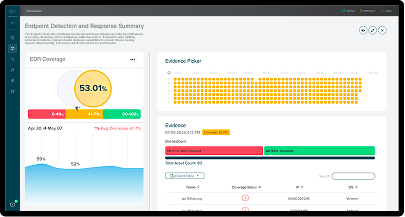
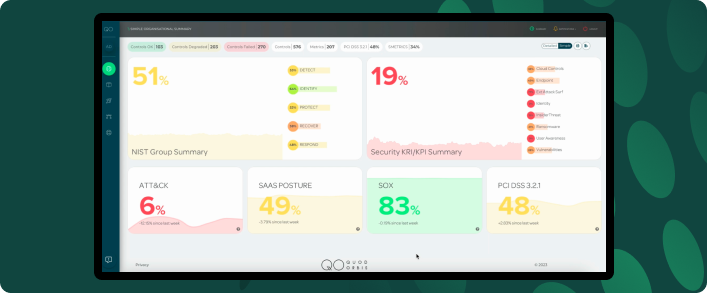
Most consultancies deliver a framework and leave, but Quod Orbis goes further. Our Continuous Controls Monitoring platform sits underneath your AI governance framework, giving you real-time visibility of every AI tool in use, automated evidence that controls are working and board-ready reporting - continuously, not just at audit time.
What the CCM platform adds to your consulting engagement



From Consultancy to Continuous Assurance
Our CISO-as-a-Service gives you the leadership. CCM gives that leadership real-time evidence — dashboards and reporting your CISO can act on immediately.
Get in touch to learn more
Contact us today for more information on our cyber and risk consultancy services, or for an initial chat about your needs or concerns.

Your questions answered
AI governance is the set of policies, controls and oversight structures that ensure AI is adopted safely, ethically and in line with regulation, covering everything from which tools staff are allowed to use, to how models handle data, to who’s accountable when something goes wrong. It matters now because adoption has outpaced control: 60% of organisations already have AI tools embedded in their IT infrastructure, yet 87% of leaders name AI vulnerabilities as the fastest-growing cyber security risk they face. Regulation is catching up fast too, with the EU AI Act carrying fines of up to €35m or 7% of global turnover for non-compliance. Waiting until an incident, an audit or a regulator forces the issue is the costliest way to build governance — doing it proactively is far cheaper and far less disruptive.
Standard cyber security consulting is built around protecting infrastructure, networks and data from external attack. AI governance consulting covers that same external threat picture — AI-enabled phishing, deepfakes, multi-vector attacks — but adds two dimensions traditional cyber security doesn’t touch: internal risk (shadow AI, uncontrolled data exposure, unmonitored AI agents operating inside the business) and regulatory exposure specific to AI (the EU AI Act, DORA, NIS2, the UK Cyber Security & Resilience Bill). It also requires different expertise — understanding model risk, data provenance and AI-specific compliance frameworks like ISO 42001, not just endpoint and network security. In practice, we work alongside your existing cyber security programme rather than replacing it.
It depends on the size and complexity of your AI estate, but every engagement follows the same five-stage path: Discovery (typically 2–3 weeks) to establish your current AI governance posture, followed by Assessment & Gap Analysis, Framework Design, Implementation, and finally Continuous Assurance. The first four stages — getting a board-approved policy, a full AI tool register and technical guardrails in place — are the project-based part of the engagement. Continuous Assurance then runs on an ongoing basis, so governance keeps pace as your AI use evolves rather than becoming another static audit that goes stale within months.
An executive sponsor who can champion the programme internally, and access to the people who already touch AI in your business — IT, legal, compliance, and the teams actually using AI tools day to day. From there, the Discovery phase does the heavy lifting: we run the interviews, technical discovery and tool scanning needed to map your current position, so you don’t need a governance framework or even a full inventory of AI tools already in place before we start.
We work embedded alongside your teams, not in place of them. Legal and compliance shape the policy and risk appetite statement so it reflects your existing obligations; IT owns implementation of the technical guardrails — DLP, API gateways, LLM configuration, access controls — that we design together; and we help establish (or plug into) a governance committee with clear escalation paths so ownership sits with your people once we’ve handed over. Our consultants; former CISOs, compliance directors and regulatory specialists; are there to bring the AI-specific expertise your teams may not have in-house yet, not to duplicate the expertise they already do.
No. Many organisations engage us precisely because they suspect — or know — that AI tools are already in use without any formal oversight, which is exactly the gap Discovery is designed to close. Whether you have a mature AI programme, a handful of sanctioned tools, or nothing formal at all, the process starts from the same place: establishing an accurate, evidence-based picture of what’s actually being used.
Our framework is built to address the EU AI Act, DORA (Digital Operational Resilience Act), NIS2 and the UK Cyber Security & Resilience Bill, and aligns with ISO 42001 (AI management systems), ISO 27001 and NIST. Because most organisations are managing several of these simultaneously, we map controls once and reference them against each relevant framework, rather than building separate, duplicated governance for every regulation you’re subject to.
Shadow AI is any AI tool or capability being used inside your organisation that hasn’t been formally assessed, approved or brought under governance — typically adopted by individual teams or employees faster than IT and security can track it. It’s one of the biggest blind spots in AI risk precisely because, by definition, it doesn’t show up in existing asset registers. We identify it during Discovery through a combination of technical scanning, stakeholder interviews across business units, and — where deployed — the CCM platform’s real-time visibility across your AI estate, which surfaces sanctioned and unsanctioned tools alike rather than relying on a one-off manual audit.
This is what the Continuous Assurance stage — and the CCM platform behind it — is built for. Rather than a point-in-time audit report that’s out of date within weeks, you get continuously generated evidence: automated monitoring of your controls, board-level dashboards showing governance posture at a glance, and an audit trail regulators and auditors can review directly. It shifts the conversation from “here’s what we did at the time of the last review” to always-on proof that controls are operating as intended.
The consulting service is the human-led engagement that designs and stands up your AI governance framework — the policies, risk appetite, controls and training that give you a functioning programme in the first place. The CCM (Continuous Controls Monitoring) platform is the technology that keeps it running: real-time visibility of your AI estate, automated evidence collection and board-ready reporting, so governance doesn’t quietly decay back into a point-in-time exercise once the consulting engagement ends. Most clients use both together — consulting to build the framework, the platform to prove it’s still working six months, a year, five years later — though each is also available on its own.
Yes — and we’d expect to. Very few organisations are starting from zero on compliance, so our approach is to map AI-specific controls onto the governance structures, risk registers and evidence processes you already have for ISO 27001, DORA or similar frameworks, rather than standing up a parallel programme. That keeps the audit burden on your teams down and means AI governance reinforces your existing compliance posture instead of duplicating it.
It’s a short, no-obligation conversation to understand where you currently stand — what AI tools are already in use (as far as you know), what’s driving the need for governance right now (a regulation, an incident, a board request), and who the right stakeholders are internally. It’s a scoping conversation, not a sales pitch: by the end, you’ll know what a full Discovery phase would look like for your organisation and what it would involve from your team. You can book one directly from the AI Governance page, or call +44 (0)203 9622206.
To find out more about cyber security and Continuous Controls Monitoring, please complete the form below with a short message and we’ll get right back to you. Alternatively, you can book a meeting directly.
Address:
5th Floor,
72 King William Street,
London,
EC4N 7HR
Email:
[email protected]
Please register your contact details with us to receive links to insightful blog articles as soon as they are published.
Address:
2nd & 3rd Floor,
2 Burgon Street,
City Of London,
London,
EC4V 5DR
Email:
[email protected]
Please register your contact details with us to receive links to insightful blog articles as soon as they are published.