Book a Demo
Skip to contentCompare the capabilities and features of Quod Orbis and Logicgate. See which solution performs best across a range of categories, from compliance frameworks to risk reporting and integrations.

LogicGate has been on the Inc. 5000 fastest-growing private companies list five consecutive years. That is not an accident. It built a genuinely flexible, well-engineered GRC platform and found a real market for it. This page is an honest look at where LogicGate excels, where its model has limits, and how to think about the choice between the two.
Integrated GRC module alongside continuous controls monitoring
Core strength — 40+ pre-built applications, graph-database architecture enabling cross-application risk relationships
Always-on, hourly cadence, any control, any system
Workflow-triggered: controls assessed when a cycle runs
Source-agnostic — any tool, custom system, OT or legacy
SaaS and cloud focus
Predictive: forecasts control drift and failure, scores by business impact, prioritises remediation
Administrative: auto-fills fields, links records across applications, drafts content
Integrated risk analytics and AI scoring
Via Risk Cloud Quantify (FAIR)
Actionable for every team
GRC workflow focused
Pre-mapped, continuously maintained
Partial
Any data source, without rip-and-replace
Limited
Predefined templates, faster time-to-value
High for non-enterprise teams
Modular tiers, published
Bespoke, quote only
Included as standard
Available
At a glance
Integrated GRC module alongside continuous controls monitoring
Core strength — 40+ pre-built applications, graph-database architecture enabling cross-application risk relationships
Always-on, hourly cadence, any control, any system
Workflow-triggered: controls assessed when a cycle runs
Source-agnostic — any tool, custom system, OT or legacy
SaaS and cloud focus
Predictive: forecasts control drift and failure, scores by business impact, prioritises remediation
Administrative: auto-fills fields, links records across applications, drafts content
Integrated risk analytics and AI scoring
Via Risk Cloud Quantify (FAIR)
Actionable for every team
GRC workflow focused
Pre-mapped, continuously maintained
Partial
Any data source, without rip-and-replace
Limited
Predefined templates, faster time-to-value
High for non-enterprise teams
Modular tiers, published
Bespoke, quote only
Included as standard
Available
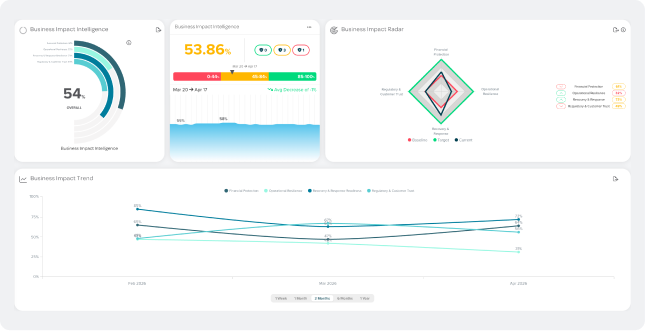
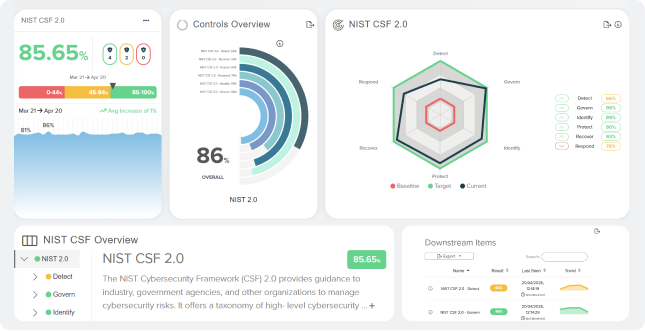
Quod Orbis is a continuous controls monitoring platform. The distinction from LogicGate is architectural, not cosmetic. LogicGate automates GRC workflows. Quod Orbis monitors your control environment continuously — 24 hours a day, seven days a week — and surfaces control drift the moment it occurs, before it becomes a business risk or a compliance failure.
“As the business has seen the power of Continuous Controls Monitoring, and seen how Quod Orbis literally can connect to almost any control, we’ve implemented CCM in areas that weren’t originally envisaged. — Head of Cyber Oversight, Direct Line”
LogicGate’s Risk Cloud is a no-code GRC platform built on a graph database architecture that lets risks, controls, and applications connect to one another across the programme — a genuine differentiator for organisations whose GRC needs span multiple use cases. The platform comes with 40+ pre-built applications covering enterprise risk, cyber risk, third-party risk, compliance, audit, policy management, and operational resilience. Risk Cloud Quantify adds financial risk modelling through Monte Carlo simulation and Open FAIR — for organisations that need to translate cyber risk into dollar terms for boards and CFOs, this is a meaningful capability.
The constraint is the model itself. LogicGate’s strength is workflow automation. What it does not do is continuously monitor your controls in real time, independent of workflow triggers. Between cycles, things change — and the platform will not tell you until the next review fires.

Quod Orbis is a continuous controls monitoring platform. The distinction from LogicGate is architectural, not cosmetic. LogicGate automates GRC workflows. Quod Orbis monitors your control environment continuously — 24 hours a day, seven days a week — and surfaces control drift the moment it occurs, before it becomes a business risk or a compliance failure.
“As the business has seen the power of Continuous Controls Monitoring, and seen how Quod Orbis literally can connect to almost any control, we’ve implemented CCM in areas that weren’t originally envisaged. — Head of Cyber Oversight, Direct Line”
LogicGate’s Risk Cloud is a no-code GRC platform built on a graph database architecture that lets risks, controls, and applications connect to one another across the programme — a genuine differentiator for organisations whose GRC needs span multiple use cases. The platform comes with 40+ pre-built applications covering enterprise risk, cyber risk, third-party risk, compliance, audit, policy management, and operational resilience. Risk Cloud Quantify adds financial risk modelling through Monte Carlo simulation and Open FAIR — for organisations that need to translate cyber risk into dollar terms for boards and CFOs, this is a meaningful capability.
The constraint is the model itself. LogicGate’s strength is workflow automation. What it does not do is continuously monitor your controls in real time, independent of workflow triggers. Between cycles, things change — and the platform will not tell you until the next review fires.

LogicGate's AI makes the GRC process faster. LogicGate's AI speeds up GRC administration — auto-filling fields, linking records between applications, and drafting content. That genuinely reduces manual effort in workflow-driven programmes.
Quod Orbis's AI is doing a different job. It applies predictive risk scoring to your live control data, identifying which controls are most likely to fail, ranking risks by business impact, and surfacing what to remediate first. The AI is not administering a process — it is actively reducing risk exposure.
LogicGate's model is trigger-based. A workflow fires, evidence is collected, a risk is assessed. The platform is excellent at managing that process. The limitation is what happens between triggers — a control that was compliant when the workflow last ran may not be compliant now, and LogicGate will not tell you until the next cycle.
Quod Orbis detects control drift the moment it happens. There is no cycle to wait for. Customers have reported audit preparation reductions of up to 75% — because evidence is continuously collected and the AI has already flagged what needs attention.
Which one is right for you?
Quod Orbis tends to be the right fit when…
LogicGate tends to be the right fit when…
Connect to your existing tools
The solution integrates with any data source, whether cloud, on premises or legacy, without requiring rip-and-replace.
Monitor controls continuously
The solution runs 24/7, detecting control drift the moment it happens and alerting your teams before it becomes a business risk or compliance failure.
Translate signals into impact
The solution correlates and contextualises data, delivering KRI and KPI dashboards calibrated for every level of your organisation.
LogicGate is a well-built, credible GRC platform for enterprises that need configurable workflow automation and financial risk quantification. Quod Orbis is for organisations that need GRC to connect to real-time, continuous controls monitoring with AI that predicts what is going wrong before it happens. Both platforms run GRC programmes. Only one keeps your controls continuously visible and your risks continuously scored.
To find out more about cyber security and Continuous Controls Monitoring, please complete the form below with a short message and we’ll get right back to you. Alternatively, you can book a meeting directly.
Address:
5th Floor,
72 King William Street,
London,
EC4N 7HR
Email:
[email protected]
Please register your contact details with us to receive links to insightful blog articles as soon as they are published.
Address:
2nd & 3rd Floor,
2 Burgon Street,
City Of London,
London,
EC4V 5DR
Email:
[email protected]
Please register your contact details with us to receive links to insightful blog articles as soon as they are published.